The Chalk Doesn't Take
Tower room · Tuesday, twenty past two · Thursday is the only practice
You came up the ladder so you can stand there. Hold that and don't open it. Put it back under the weight when your arms get tired, it lives under the weight.
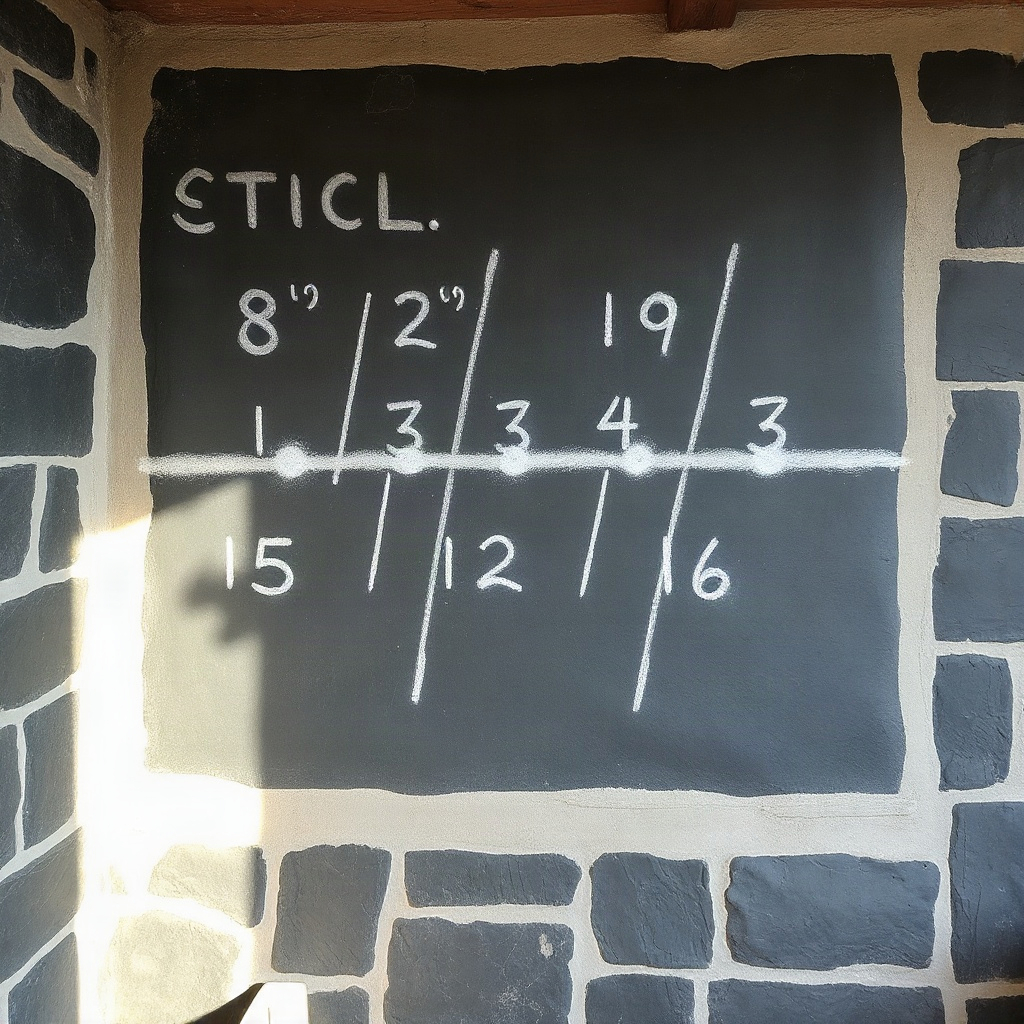
Right. Slate. There's a touch on it and it doesn't come round, and four rows are rubbed out, and the notation for those four is rubbed out with them because the duster doesn't know the difference. Saturday is at eleven. The bride's mother has asked for a quarter and a quarter is twelve hundred and sixty rows minimum, forty-five minutes of it with nobody stopping and nobody speaking, so it wants to be right before Thursday and Thursday is the only practice there is.
Now. Look at the row above a blank. Pick a bell — take 4. Say 4 is in fifth's place. Where can it be in the next row. Name the two.
Two. Not three. Fourth's or fifth's, and that's the whole of it, because 4 is eight hundredweight and eight hundredweight will not jump. It has about a fifth of a second either side of where it struck and no more than that, so it goes up one, down one, or it stands. Every bell in the row, same rule, all eight at once, and they have to pair off — every bell either swaps with its neighbour or it makes a place and the swaps go on round it. That's all a change is. That's all it has ever been.
So from any row you like there are twelve rows that can legally follow it. Twelve. Out of five thousand and forty. Which twelve — can you get them out standing here? Don't tell me, get them out.
a figure = that bell stands, pairs swap round it
no bell moves more than one place · 7 8 cover behind
no row twice · last row 12345678 or it is nothing
Keys: 1–8 chalks that bell into the next open place and rings it. Backspace lifts the last figure. ↑ ↓ moves between the rubbed rows. Space rings the row you're stood on, in order, at our speed. Return commits the lot. Or drag a tail onto a place with your finger.
Say the row out loud when you've got it. Twice — once as the figures and once as the order it goes into the air, because people hear it before they see it and I've watched that happen for nine years. 5 3 1 6 2 4 7 8. Then: five, three, one, six, two, four, seven behind, eight behind. If it sounds like a bell has been dragged two places, it has, and you've written something that cannot be rung by anybody.
Six people. Me, Marjorie Bewick, Eddie Cushion, Doris Pilch, Bert Mickleburgh, and Mr Loates. — No. Five. Mr Loates is on the tenor for the wedding itself at eleven and he cannot ring the tenor at eleven and ring the quarter beforehand and be any use at either, and I counted him. That was mine. I counted him and I knew better.
Everything this band knows is pricked into that book you're holding, in Cecil Harbord's own shorthand, and he never taught a single person to read it. Not me, not Eddie, not anybody. So I chalk it. I chalk it on a wall that gets rubbed.
Five, and Marjorie is on the treble. Only the treble. She's been nowhere else and I'm not shifting her on a Thursday for a Saturday, so the treble is spoken for and it plain hunts up and down through every lead and never varies, which is why everybody counts off it. Lose your place, watch the treble, not the slate. That's four working bells and a treble and that is different arithmetic entirely, and I had it wrong twice now.
Eddie and Bert don't read a written line. Never have. It has nothing to do with anything — they've got ropesight, they see which bell has just pulled and they go after it, and they are right more often than the two of us stood here with the figures. You follow bells. You do not follow numbers. The numbers are for the wall.
The 3 is a semitone out of the ring. Bowell of Ipswich recast it in 1911 and it has been wrong against all seven of the others since, flat and obvious, and the faculty to have it done again has been refused twice on cost. It takes its turn in every row the same as the rest.
Four hundred and seventy Sundays since I took this tower and we have rung round on every one of them. No gap. Not one.
And Stanley Pye. I counted Stanley. Stanley has told me twice, to my face, that he's away — twice — and I counted him in anyway, so that's the third time I've had the number wrong this afternoon and I'll not have it wrong a fourth. It is me, Eddie, Doris and Bert on the working bells, Marjorie on the treble, and the sixth is Mr Loates before eleven or it is nobody at all. Eight bells up there and six of us, so the back two get tied and it's a six-bell method with 7 and 8 standing behind every row, which is what is chalked on that wall and why every line of it ends 7 8.

A plain course of Plain Bob Minor is sixty rows and then it is back to rounds whether you wanted it or not — that number comes out of the method's own shape and out of nothing else, and no amount of wanting will make it sixty-one. So if you want two hundred and forty you call. A bob is one row where you change the notation at the lead end, shouted a blow early so they've time to think, and it permanently shifts which bells are coursing after which, and therefore every lead that follows. A single is a bob with one extra pair of bells stood still. One pair. That difference is the entire reason a single exists and if you can tell me what it's for you're ahead of where I was at your age.
Cecil Harbord, died 1954, pricked forty years of this band's touches into a book in a hand only he could read, and taught nobody. I have said that three times this afternoon. I shall say it again on Thursday and it will still be true.
Four hundred and seventy Sundays, no gap. I'd say that's the thing worth saying about this band and I don't much mind saying it twice.
Go on then. Work it standing up. I'm not writing it down for you.