Zeeland order — tie-up sheet
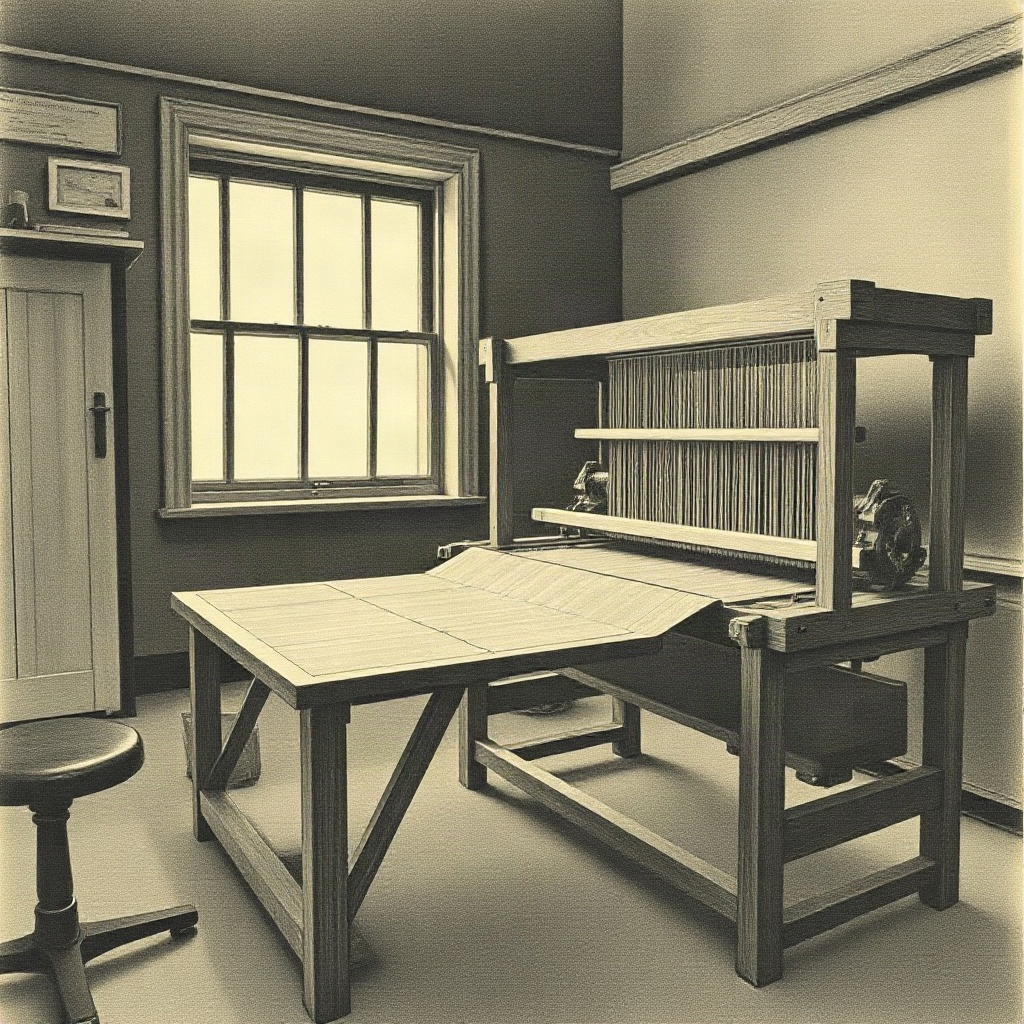
The loom
The sheet
Cording board, under the castle
— margin of the sheet. Nothing written here yet.
On the bench, three sheets
Sheet 1 — Monday, ten to seven
For whoever comes in at eight. I have taken the truck to Grand Rapids to argue with Zeeland about the price and I do not expect to be back before three. Everything on the loom is ready except the one thing I could not settle without seeing their swatch in daylight, and now that I have seen it in daylight I still cannot settle it, so I am leaving it to you.
- The threading is in. Straight draw, 1 2 3 4 across the four shafts, 428 ends at 15 to the inch. I put it in myself over two evenings last week and counted it against the raddle twice; it is right. It is also not changeable this morning. If you decide at half past ten that the pattern wants a different threading, the answer is that it wants 428 ends pulled out of the heddles, and I will not have it.
- The treadling is chalked on the castle and it is the customer's order, not mine: four picks on the twill treadles, two on the tabby pair, and round again, sixteen picks to the repeat. Leave the chalk where it is. The sheet on the bench is ruled to sixteen picks by thirty-two ends, which is one repeat each way, and that is all you need to look at. What holds for the repeat holds for the yardage.
- So the tie-up is the whole of the job this morning. Six treadles, four shafts, nothing corded. Peg it on the sheet first, in the small grid in the corner where the threading and the treadling come together, and cord it under the loom only when the sheet weaves right.
- The rule you are working to is two lines long. A square in the drawdown is warp-up if and only if that end's shaft is raised by that pick's treadle. If it is not raised, the weft lies over it and the square is weft. That is all of it. Nothing here is a matter of taste; the pattern is not designed, it is worked out, the same way a bill is worked out, from three columns that are already fixed except one.
- Two yarns on the loom and no third: the green worsted in the warp, the mustard in the weft. Where a place looks green it is because the warp is on top there; where it looks mustard the weft is. Where they change square by square you will see both in a checker, and that is a balanced cloth, not a fault.
— You will want to know whether the order you peg them in matters. It does not. The bench engine redraws the sheet from the arithmetic every time, and it does not remember what you did first.
— The paper is only paper. The shed will tell you more than the paper will; press Beat in and watch the picks go in one at a time rather than sitting and staring at squares.
Sheet 2 — the shed, and floats
- This is a counterbalance loom. The shafts you cord to a treadle sink, and the ones you leave loose come up. A peg plan for this loom is therefore the exact photographic negative of a peg plan written for a jack loom, and if you take a tie-up out of a book without checking which loom the book meant, you will weave the cloth perfectly and inside out for thirty-two yards. The switch on the beam is set to sinking and that is correct for us. Throw it if you want to look at the negative, and then throw it back.
- Two down against two up on every treadle you use. Three shafts pulling against one will not open a clean shed on this loom, however handsome the pattern looks on paper: the shed comes up half open, the shuttle catches on the ends, and you have a broken pick and a mend. DON'T cord any treadle with three pegs in its column. I have set the bench engine to refuse the pick outright rather than let you find that out at pick nine hundred.
- Floats. A float is a thread running over more than a few of its neighbours before it ties down again. This is upholstery, it is going onto a chair arm, and anything much over a quarter of an inch will catch a coat button and draw. At 15 to the inch a quarter inch is three threads and a bit, so I have set the limit at four: any run of four or more, warp or weft, gets marked in red on the cloth and the tie-up is rejected on the spot. A tie-up can match their swatch square for square and still be no good to us. It will happen to you at least once. Take it as arithmetic, not as a verdict.
- About the swatch. I am fairly certain it is face down — they cut it off the arm with a knife and put it in an envelope, and there is no reason it should have landed right side up. What that means for you is that 3/1 and 1/3 are one peg plan looked at from its two sides, so do not assume the face you are holding is the face the customer will sit on. I would rather you satisfied yourself on that than took my word for it.
- Pick 11 in their piece is a doubled pick. Whoever wove it pressed the same treadle twice running, so the eleventh row of the swatch is nothing but the tenth row over again, and the line breaks by one pick there. It is their error and not yours, and there is no tie-up on earth that will reproduce it. I have told the bench engine to overlook that row in the comparison. Do not chase it.
— I am sorry for the writing on this sheet. The pencil went blunt about the second point and I did not want to stop and cut it.
Sheet 3 — the arithmetic, and the envelope
- Thirty-two yards at 15 picks to the inch is 540 picks the yard and 17,280 treadlings altogether. I put the figure down only so you understand there is no going back to fix pick 400. Whatever gets corded under this loom this morning is what they get in every inch of it, and a mistake, if there is one, will be evenly distributed through all thirty-two yards.
- Time. They want it the 27th, which is nine working days. I can weave four yards in a day if nothing breaks and nobody comes up the stairs to talk. So we have a little room, but not a week of it. Settle the tie-up this morning, cord it after dinner, and start.
- Sett is thread count and not tightness. 15 ends to the inch at this grist beats down to about 15 picks, so a square on the point paper is a genuine square and the cloth on the sheet is the shape of the cloth on the beam. Do not tighten anything to make the count come out.
- There is a shop envelope at the foot of the bench marked TIE-UP AS CUT. It has the peg plan in it as I read it off their swatch on Saturday with a glass, and nothing else — no working, because I did not write any down. I would like you to have had two honest goes at it before you slit it open. Not on any principle: you will have to cord this loom again in March when the second order comes in, and I would rather you knew how it went in the first time. The engine will not let the knife into it before then in any case.
- If it weaves right on the sheet, cord it under the loom and then take the shed apart with your hand before you throw a pick in wool. The shed will tell you more than the paper will.
— If the shoe man starts his finishing wheel downstairs and the loom walks, put the wedge under the near leg. It is behind the cone rack.
— The money in the tin is for the shuttle and nothing else.
— H. Vandersteen