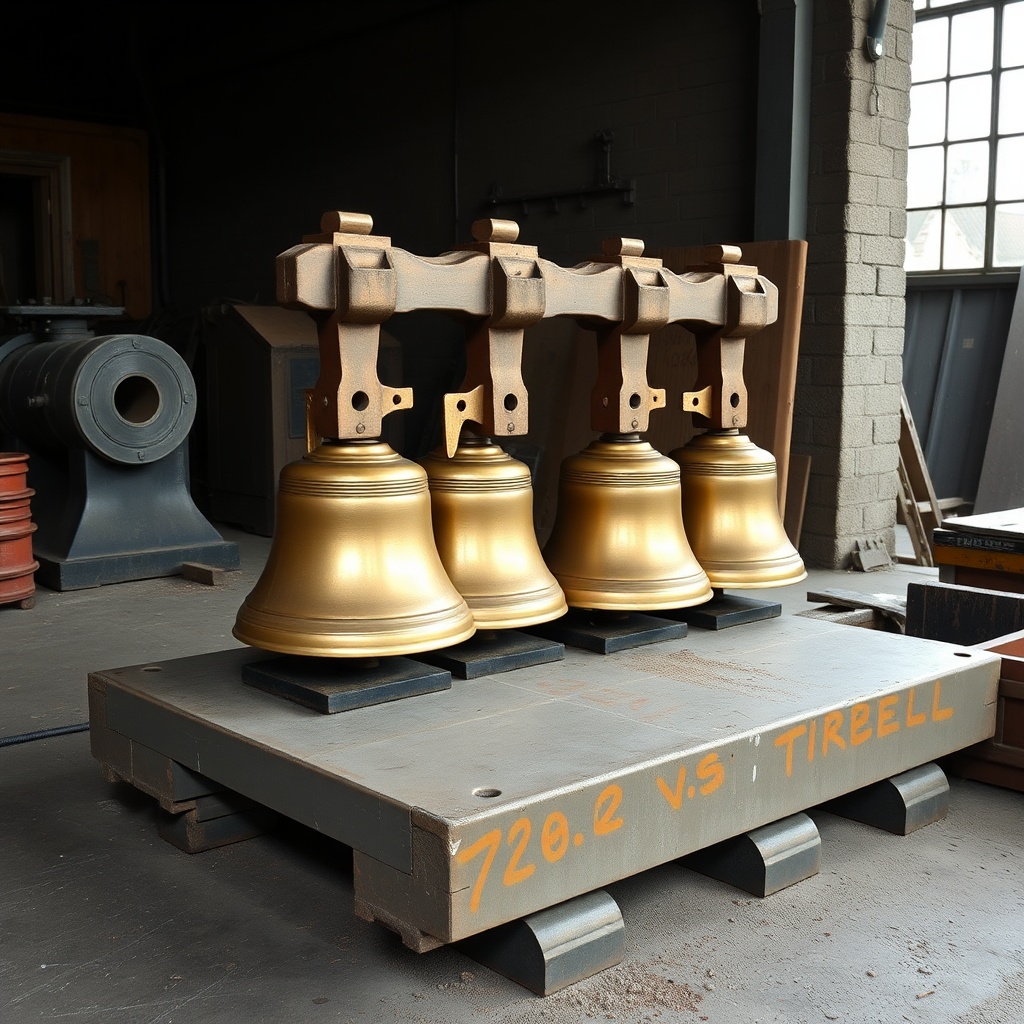
Five up
on the felt
Tuning shed apron · Tuesday, half past nine · one of these is light
Right — gloves off, get over here. Lathe's still winding down, don't lean on it. Five bells out the sand this morning, all turned true, all looking a picture, and one of them's a wrong 'un. Core shifted in the mould. Wall's thin down one side, so she's light, and light means she'll ring flat as a Tuesday when Adelaide gets her out the straw. Not having that.
Now. You cannot see it. I've had the outside off on the lathe, they're all the same shape, same skirt, same polish. And don't tell me you'll listen for it, because half of them are still warm and warm bronze lies to you. The beam doesn't lie.
Three weighings. That's what you get, because I want this crate lidded before dinner. Drag them onto the pans — and put more than one on a side, go ON, that's the whole trick. When you know which, take the striker to it. If it thuds, you've got her.
No. 3 Beam · Kegley
On the felt pads (drag one onto a pan)
STRIKER — name the light one. One swing only.
Three on a side. That's how you do five in three, and if I catch you weighing them one against one like young Ferris does I shall say something you'll remember. Two and two first. If the beam sits dead level, your dud's the one still stood on the felt and you've had it in one go and I'll buy the tea. If it dips, the dud's up on the high side, and now you've two suspects and two goes spare, which is generous.
Chalked on the shed door, left of the hinge
DUDS PULLED BEFORE CRATING: 0
CAUGHT IN — WEIGHINGS — BEST
(rubbed out and re-done that many times the paint's gone off the door)
Why light means flat
You pour bronze into the gap between the outside mould and the core, and the gap is the bell. If the core floats or shifts while she's filling — and it will if the chaplets are shy, or if somebody's rammed the loam unevenly, which happens on a Monday — then one side of the gap is fatter and the other side is thinner. She still cools into a perfectly bell-shaped bell. Nothing on the outside says a word about it.
But she's got less metal in her than her four sisters, and the thin arc doesn't stiffen the way the thick arc does. So when she's struck she comes out under pitch and she comes out sour with it, because the hum and the nominal go their own separate ways instead of sitting nicely a couple of octaves apart. You can tune a bell down on the lathe all day long — take metal off the inside, drop the note. You cannot tune one back up. There's no putting bronze on.
Which is why she goes back in the melt
Straight in. She's a hundredweight-and-a-bit of perfectly good gunmetal and she'll be a better bell next Thursday. There's no sentiment about it and nobody's sad, least of all me — the sand's still in the box, the pattern's on the bench, we'll draw another one before the week's out. What I will not do is crate her, because a bell that goes twelve thousand miles in a straw nest and arrives flat is a bell that comes twelve thousand miles back, and I would rather melt her here where the furnace already is.
Why the beam and not the ear
People come round the shed and are very disappointed when I put a bell on a scale. They want tuning forks and a face of terrible concentration. Fine — we do use the forks, that's the whole afternoon, and I'll take a fork to every one of these before the lid goes on.
But at half past nine on a batch of five with the metal still warm on the shoulder? A warm bell rings sharper than a cold one. Not by a lot. By enough to muddle you exactly at the point where a light bell rings flatter by not-a-lot. Put the two errors together and the ear tells you a story you can't check. Meanwhile the balance has never once cared what temperature the bronze is, and a shifted core takes four or five pounds out of her, and four or five pounds you can see from across the apron by the way the beam falls off its stop.
And why in groups
Because a weighing has three answers, not two: left down, right down, or dead level. One-against-one throws away the third answer nearly every time. Two-against-two spends one weighing to split five bells into a group of two suspects or a straight identification. Ferris weighs them one at a time against a known-good and calls it thorough. It's not thorough, it's four weighings for a job that takes two, and the crate doesn't lid itself.
Go on then. And when you get her, I want to hear the difference — a sound bell struck bare-handed on the apron gives you that long bronze ping that hangs about. The dud gives you a wet clap of a noise, like dropping a spanner in a bucket. Once you've heard the two next to each other you'll never mistake it again. Doesn't help you find her, mind. Only tells you you were right.
Show me the scales
Fine, fine — but you've not even had a proper go yet.
The one clean way to do it in two
Bells one and two on the left. Bells three and four on the right. Bell five stops on the felt.
| The beam does | Therefore | Second weighing |
|---|---|---|
| Sits dead level | Both sides match, so the light one is No. 5, alone on the felt | None needed. Strike it. |
| Left goes up | Light bell is 1 or 2 | 1 against 2. Whichever rises is her. If they level, you've mis-set something. |
| Right goes up | Light bell is 3 or 4 | 3 against 4. Same again. |
Two weighings, worst case. Third one spare for if you fumble a bell off the pan, which you will, because the rims are polished and the pan is greasy and it is a Tuesday.

What's in the crate on Thursday
Four handbells, two crates of straw, one tin of the wax we use on the handles, and a note in my writing telling whoever unpacks them that the leather wants oiling before anybody swings them, because six weeks in a hold does no leather any favours at all. Two hundred and nine pounds the lot, carriage paid to the docks, and stencilled on the lid in orange because that's the paint that was open.
The fifth bell goes in the furnace bay by the door, mouth down, with a chalk cross on her so nobody puts her in a crate by mistake at four o'clock when the light's going.