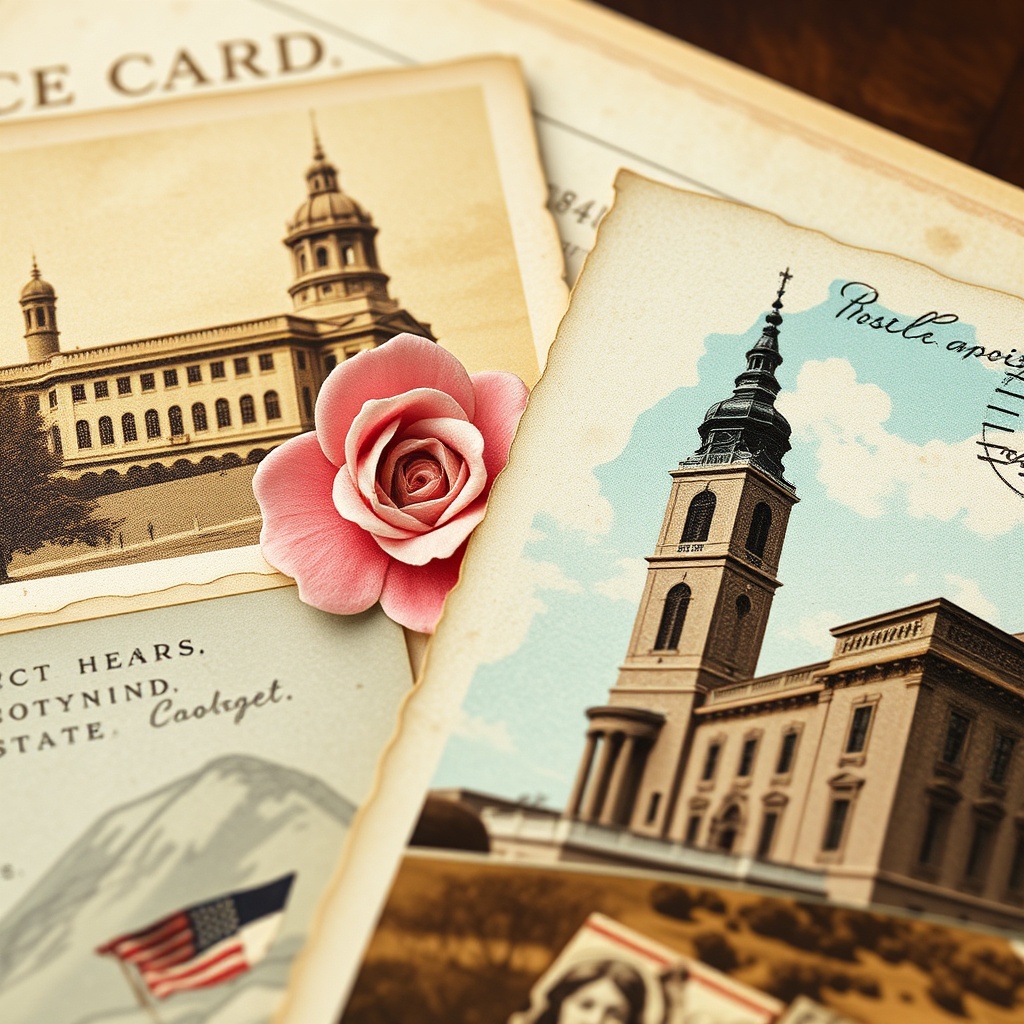
Marshfield, Massachusetts · the year nineteen-hundred-five
Dear visitor — please make yourself comfortable at the parlor table. I have laid out three of my albums for your perusal this afternoon, and you are most welcome to handle the cards (with a kindness for the corners, if you please). What a wonderful age we live in, when a card mailed from Dresden reaches me here in three weeks for two cents the postage, bearing a faithful reproduction of a Raphael Madonna so finely chromolithographed that the cherubs' eyes follow you across the page.
Below the cards are arranged for browsing. You may sort by Subject, by printing Method, or by Region of origin. If you have a card of your own to add to the collection, the entry form at the foot of the album shall record it for future visitors. The Lighthouse Society writes that we are now nearly four million collectors across the country — we are a great quiet army, all of us looking after the same small beautiful papers.
— Eleanor Whitmore, March, 1905
Albums presently open
Sort the cards
By Subject
By Method
By Region
From Mrs. Whitmore's collecting journal
February 9th, 1905
Spent the morning re-sorting the Continental album by publisher rather than country, as Mrs. Albright recommended at last month's society meeting. She is right that it surfaces the Stengel cards beautifully — their tinting work is plainly head and shoulders above the rest, and grouping them lets one see the house style across forty pictures at once.
March 14th, 1905
Mrs. Hartley's parcel reached me at last — what wonders inside! The Sistine cherubs from Dresden, after eighteen months of patient correspondence with her brother-in-law at the customs house. The chromolithography on this specimen surpasses anything I have previously held; Stengel & Co. have achieved a depth in the blues I would not have believed possible from a paper card. Cards cross winter miles — from Dresden to Boston post — images find homes. I cataloged it today as Fine Art / International / Chromolithograph and tucked it on the third page beside the other Madonnas.
March 28th, 1905
Henry posted me an Eiffel Tower from Paris with the most charming complaint about the cabmen there. I shall write back tonight and ask him to find a Mucha if any are to be had — the Czech printers are doing astonishing things with women in flowing robes and I should very much like a representative example before the supply tightens.
Add a card to the collection
A small key from Mrs. Whitmore: should you type the name of a great painter (the one who painted the Madonnas), the publisher's spring catalogue will appear.
The front of the card
The back, in the sender's hand
Condition
Trading notes
Raphael Brothers — Spring Catalogue, 1905
Fine Art Postcards · London & New York · Established 1898
From the catalogue
[A four-page folded broadsheet on cream paper, hand-set in two columns. Page 1 lists prices: Series A (chromolithograph, 6 cards in envelope) at twelve cents the set; Series B (German triple-coated chromos, mounted) at three cents each, twenty-five cents the dozen; Real Photographic mounts at five cents each. Page 2 lists subjects available: "Old Masters Series — Raphael's Madonnas (eleven varieties), Vermeer interiors (six), Velázquez courts (four), the complete Botticelli Primavera in four panels for ten cents." Page 3 describes the chromolithographic process — fourteen stones, hand-registered, with the foreign-printed plates received from our Dresden affiliates and finished here. Page 4 prints mailing instructions: "One cent will carry your card anywhere in the United States; two cents to any other civilized country. We ask only that you write the address legibly and place the stamp at the upper right corner."]
A letter, enclosed with the catalogue
Dear Mrs. Whitmore,
I write to thank you for your continued patronage and to share an honest enthusiasm. Twenty years ago, a clerk's daughter in Ohio could not see the Sistine Madonna without traveling to Dresden. Today, for three cents and a stamp, the same girl pins it above her writing desk and looks at it every morning before school.
This is not a small thing. This is the most important thing I know of in the whole of visual culture. We are not selling souvenirs — we are running a network. The post is the gallery. Every front room with an album in it is a wing of a museum the size of the country. The chromolithograph is not a poor cousin to the oil painting; it is the thing that finally allows ordinary people to live inside the company of pictures.
We will keep printing them as long as you keep collecting them. Please write if a particular subject is wanted — we have correspondents in Florence, Munich, and Kyoto.
Yours in the work,
R. Raphael, for the firm