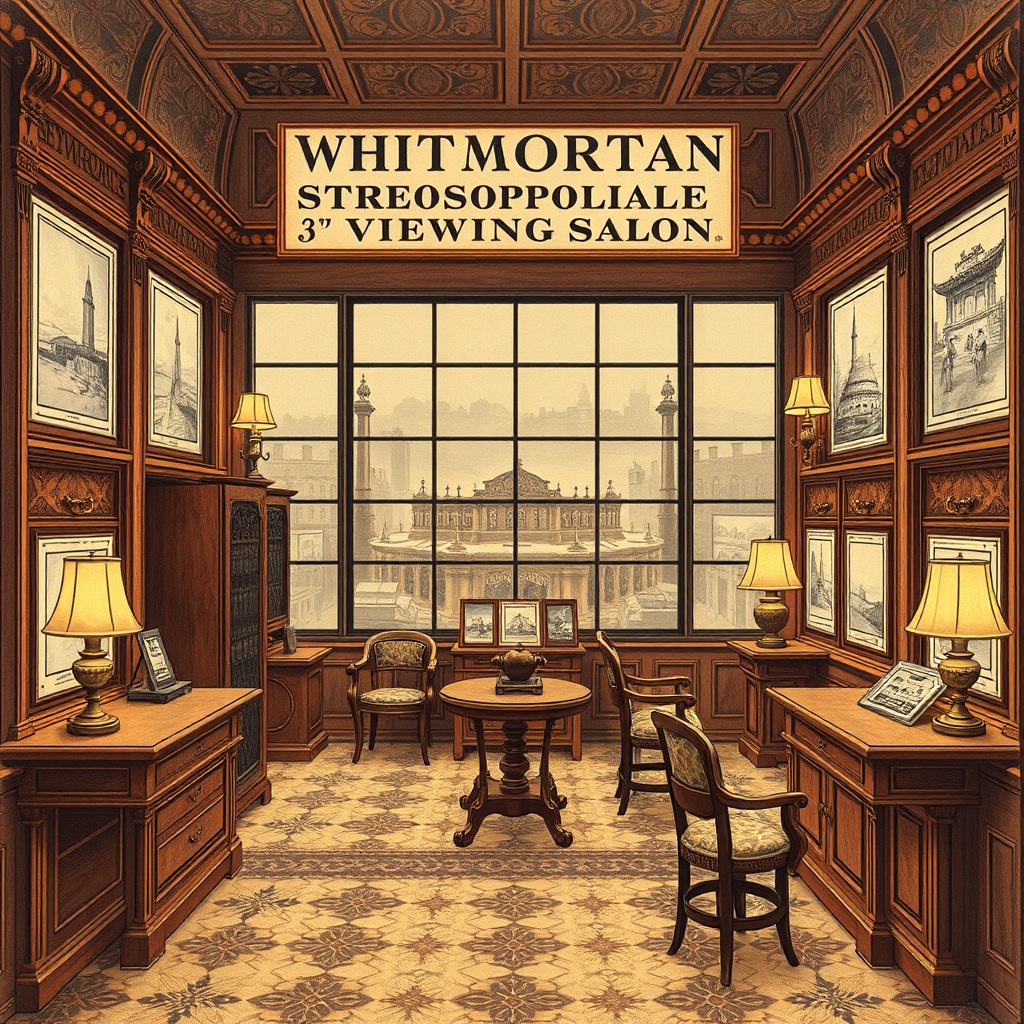
Tremont Street · two flights up, above Hatcher's apothecary
Whitmore's Metropolitan Stereoscope Viewing Salon
A curated collection of three-dimensional photographic card pairs, open daily from ten in the morning until nine in the evening. Five cents the visit; viewers and reading-spectacles provided at no charge. Boston, in the year 1885.
The Cabinet of Cards · 24 views presently catalogued
From the Curator's Top Drawer
Two papers, kept folded together since the spring of 1884.
I. The Apparatus. The improved Holmes-pattern viewer consists of a hooded sight-piece in walnut, twin biconvex prismatic lenses set at the operator's interocular spacing (nominally 2½ inches), a sliding card-holder of brass wire, and a folding privacy-hood lined in black velvet to exclude stray salon light.
II. Optimal Convergence. The patron is instructed to draw the card-carrier toward or away from the hood until the two adjacent images fuse into one apparent scene with depth. The proper distance varies between four and seven inches according to the patron's vision; spectacled patrons should retain their lenses.
III. Illumination. Hold the apparatus so that ambient salon light strikes the card surface at a low oblique angle (15°–25° preferred). Direct overhead lamplight produces glare upon the albumen and flattens the sense of depth.
IV. Maintenance. The lenses are to be wiped weekly with a soft chamois moistened with rectified spirits of wine. The brass card-rail oiled monthly with a single drop of clock-oil at the slide-pin. The velvet hood-lining brushed against the nap with a horse-hair brush.
To my friend Mr. Halliday at the New York salon —
You ask whether all this work is worth the candle. I tell you: yes, and twice over.
I had a tinsmith's apprentice in my chair last Thursday, sixteen years of age, never been farther from Boston than the harbour boats. I set into the carrier a card of the Schaffhausen Falls. He drew the lens to him and held still — and then his hand began to tremble, and he said, very quietly, "They are right there. The water is right there. I could put my hand in."
That boy will never in his life ride a steamer to the Rhine. He will not see the Pyramids, nor stand below the Matterhorn, nor walk under the palms in Kew. But on Thursday he did stand below the Matterhorn, by the only honest road available to him, and he came out of that chair with a wider world inside his head than the one he carried in.
This is what we are building, my friend. Not amusement. Not novelty. An honest cartography of wonder, made portable enough to climb two flights of stairs above an apothecary, and cheap enough that a working family may share it for the price of one supper. The Pyramids by Tuesday, the Grand Canal by Friday, and the boy's own city seen fresh again on Sunday.
I write you in great earnestness. Press on with your own collection. Send me a list of your most recent acquisitions; I shall do the same.
Yours in stereoscopic faith, Cornelius P. Whitmore Boston, the seventh of May, 1884